MAYOR
JAVIER LOPEZ
CERES ca
This is the official site of the Mayor of Ceres. It is not affiliated with or authorized by any political campaign. The purpose of this page is to provide community news, resources, and information for residents.
Team
Apr 21, 2026
Why the April 21 workshop was only the beginning of the City of Ceres budget process.
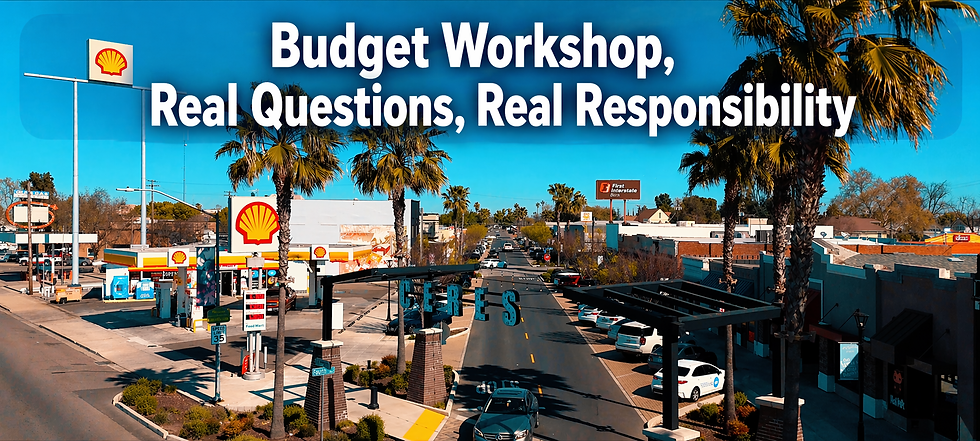
The City of Ceres held its Special Budget Workshop on April 21, 2026, as the first major step in the City’s budget process for Fiscal Year 2026–2027. This workshop was intended to provide a high-level overview of the proposed budget, explain the financial pressures the City is facing, and begin the public discussion before the budget moves forward.
It is important for the public to understand that this was a workshop, not the final adoption of the budget. The information presented was part of the process. Today’s presentation will be presented again at the April 27 City Council meeting, where the discussion will continue and where the Council will have another opportunity to review the recommendations, ask questions, and provide direction. From there, the budget process will continue before a final adoption later in the cycle.
That distinction matters. What was presented at the workshop was not the final word. It was a projection based on current information, estimated revenues, projected expenditures, and known obligations. In government, budgets are built months before all actual revenue is fully received. Even though this is the 2026–2027 fiscal year, some revenue streams are not fully realized until January or February of 2027. That means what the public saw at the workshop was the City’s best projection at this point in time, not necessarily the final year-end result.

After explaining the process, the workshop moved into the City Manager’s proposed recommendations and the financial pressures driving the conversation. Those pressures are real, and many of them are tied to expenses that the City must pay. They are not optional. They include public safety, fire protection, pension obligations, labor costs, insurance, and other operational responsibilities that come with running a city.
As Mayor, and as someone who strongly supports public safety, I understand the importance of maintaining those services. Public safety is one of the most important responsibilities we have as a City. It is also one of the largest parts of the budget for a reason. Our community expects us to protect lives, respond to emergencies, and maintain a strong and reliable police and fire presence. That requires staffing, training, equipment, and long-term financial commitment.

The same is true when it comes to employee compensation. The City has needed to remain competitive, and we have negotiated and bargained for raises in order to retain employees and continue delivering services. These are recurring operating costs, but they are also part of maintaining a professional workforce. In the same way, the fire contract has increased, but that contract has also improved fire and life safety in our community. These are the kinds of costs that must be looked at honestly. They are pressures on the budget, but they are also investments in the services our residents depend on.
The workshop showed that budget pressure is being driven largely by ongoing operating increases, especially in labor, pension, fire, and public safety related obligations. Last year’s General Fund balance was $6,997,115. Fund balance used was $635,504, which would leave an estimated ending balance of about $6,361,611. Revenue decreased by $259,696, while department expenditure requests came in at $3,420,356. At the same time, several major cost drivers moved upward, including salary, COLA, and police adjustments at about $1,538,297; the fire agreement at about $1,527,962; pension costs at about $1,457,752; workers’ compensation at $195,734; the SR911 agreement at $46,527; and animal services at $42,000.
The City Manager’s recommendations included balancing strategies totaling $3,184,005, with a projected $2,440,446 potentially coming from reserves. If that recommendation were carried forward as presented, the projected ending fund balance for FY 2027 could fall to around $2.0 million, or about 6.6% of General Fund expenses. That is well below the 18% target that was referenced in the presentation.

That is exactly why I asked the questions I did.
Some people are already trying to spin this discussion into fear and politics. One example is the recent post by a candidate for district 1, attempting to frame this workshop as if the City is suddenly in crisis, without context, without process, and without solutions. That is not responsible leadership. What I made clear during this process is that I offered several solutions and asked important questions specifically to bring down proposed costs and better understand where the City can make adjustments before moving forward.
For example, I asked questions about two of the first one-time funding items listed in the recommendations, totaling $800,000 and $500,000. I asked why we had so much sitting in reserves in those funds, why the Council had not previously been told about it in that way, and why taxpayer money that had been accumulating in IT and other areas was now suddenly being used to help cover the cost of the proposed budget. Those are fair questions. That is taxpayer money, and the public deserves to know how long it has been sitting there, why it accumulated, and whether it should be part of a broader operational strategy.
That is also why I asked staff to bring back information on what it would look like if we contracted out IT services instead of continuing the current structure. I want to see the total current in-house IT cost, the cost of contracting out, any one-time transition costs, any annual savings or added expense, and whether a change like that would improve the General Fund position. If there is a way to lower long-term cost, improve service, and get us closer to not using reserves, then that deserves a serious review.
I also raised the issue of long-term police overtime. If the goal is to reduce overtime, then we need to look honestly at why that overtime is happening. My question was simple: rather than leaving positions frozen and paying ongoing overtime, why are we not looking at whether filling those positions would reduce that pressure? The positions discussed included three officers and 2 command staff positions. We need to examine whether being fully staffed would save money in the long run and improve operations at the same time.
I also pointed out that one of the proposed reductions in the police section was based on the Chief’s plan to send trainees to the academy and hire them so the department can move toward full staffing. That matters. If the Chief believes that by filling those positions the department can reduce the need for that overtime allocation, then that should be part of the public conversation too. That is not reckless budgeting. That is identifying a long-term staffing solution instead of continuing to patch over a problem year after year.

Another issue I raised involved Community Development Director. There is an unfunded position there that is not frozen, and I believe it needs to be funded. My concern is why we are moving forward with a Planning Technician search when the higher-level leadership position needed to direct that work has not yet been funded. My recommendation was to fund the Community Development leadership role, remove the Planning Technician posting from the website for now, and then evaluate the staffing structure underneath once leadership is in place. We also need to go back and compare that against the contract costs currently being used to cover the gap, because there may be savings in funding the leadership role internally rather than continuing outside contracts for that department.
I also briefly raised examples that help show the public how budgeting works in real life. One example was health insurance. Around $51,000 was budgeted last year in the General Fund, while actual use came in around $27,825. That means the entire amount budgeted was not actually spent. That is important because it shows the difference between budgeted projections and actual year-end use. The same kind of understanding should apply when people try to pull one number out of a workshop and use it to bait the public.
The same is true when people try to make side issues sound bigger than they are. Items such as City Council personal development are a drop in the bucket compared to the broader proposals and structural questions being discussed. The real conversation is about long-term operating costs, reserves, staffing structure, public safety obligations, and whether we are making the right decisions for the future.
And that is the real point here. These are solutions. These are questions meant to bring down proposed costs, improve efficiency, and make sure the budget is built responsibly. They are not scare tactics. They are not political bait. They are part of the job.
This workshop did not prove that the City has failed to make progress over the last six years. In fact, it showed the opposite. Costs are going up everywhere. Fire, pension, labor, insurance, and public safety costs are rising across government. That is the reality cities are dealing with. What the Finance Department presented showed that their team knows what they are doing and is providing the Council with the information needed to make decisions. Now it is up to the City Council to do exactly what we were elected to do: ask questions, challenge assumptions, identify options, and make the best decision moving forward.
The community is not dumb. Our residents understand that numbers presented at a workshop are part of a process. They also understand when people are trying to hook and bait them with half the story. But this is not a game. These are taxpayer dollars. That is why this process matters. That is why questions matter. And that is why the Council must continue doing the work before any final budget is adopted.